Author: Mengmeng Li • MMlab 🔗
Introduction
In this example, we will try to solve the phase-field finite strain fracture model.
Model
In this model, the damage phase is described by an order parameter \(d\) which varies smoothly from 0 (undamaged case) to 1 (fully damaged case). Therefore, the system free energy can be read as follows:
where
where \(g(d)\) is the degradation function, and the positive energy \(\psi_{\mathrm{ela}}^{+}\) and the negative energy \(\psi_{\mathrm{ela}}^{-}\) are given as follows:
and
Thus the positive and negative part of the 2nd PK stress \(\boldsymbol{S}\) can take the following forms:
and
The fracture free energy can be given by:
with \(\mathcal{G}_{c}\) and \(l\) being the critical energy release rate and the length scale parameter, respectively.
The governing equaitons for this model are list below:
and
The history variable \(\mathcal{H}\) is calculated as follows:
Input file
In the example/pffracture folder, there are several geo file, which can be used to generate the msh mesh file for your simulation. Before we start, you should have the mesh file.
Mesh
In this case, we'll import the mesh from gmsh, which can be done as follows:
json
"mesh":{
    "type":"msh2",
    "file":"Tensile3D.msh",
    "savemesh":true
  },
Here, you should use gmsh to generate the related msh file!
Dofs
Next, you need to define the dofs, it should be \(d\), \(u_{x}\), and \(u_{y}\) for 2d case, and \(d\), \(u_{x}\), \(u_{y}\), and \(u_{z}\) for 3d case. The [dofs] block should looks like:
json
"dofs":{
  "names":["d","ux","uy","uz"]
},
Here, the sequence of your dofs name matters !!!
elmts and mates
The governings in Eq.\(\eqref{eq:stress-equilibrium}\) and Eq.\(\eqref{eq:damage-equation}\) can be implemented by using the following elmts:
json
"elements":{
  "elmt1":{
    "type":"allencahnfracture",
    "dofs":["d","ux","uy","uz"],
    "material":{
      "type":"neohookeanpffracture",
      "parameters":{
        "L":1.0e6,
        "Gc":2.7e-3,
        "eps":0.012,
        "K":121.15,
        "G":80.77,
        "stabilizer":1.0e-6,
        "finite-strain":true
      }
    }
  }
},
where type=neohookeanpffracture tells AsFem, our users want to call the neohookean fracture model.
For the material calculation, as mentioned before, several parameters are required, i.e., \(E\), \(\nu\) for the Youngs modulus and poisson ration, \(\eta\), \(\mathcal{G}_{c}\), and \(l\) for the damage evolution. Therefore, the related material block can be given as below.
then, your \(\mathcal{H}\) will always use the \(\mathcal{H}_{old}\) value from previous step.
boundary condition
For the tensile test, one can use the following bcs:
json
"bcs":{
  "fixux":{
    "type":"dirichlet",
    "dofs":["ux"],
    "bcvalue":0.0,
    "side":["bottom","top"]
  },
  "fixuy":{
    "type":"dirichlet",
    "dofs":["uy"],
    "bcvalue":0.0,
    "side":["bottom"]
  },
  "fixuz":{
    "type":"dirichlet",
    "dofs":["uz"],
    "bcvalue":0.0,
    "side":["bottom","top"]
  },
  "loading":{
    "type":"dirichlet",
    "dofs":["uy"],
    "bcvalue":"0.1*t",
    "side":["top"]
  }
},
Done? Yep, all the things is done!
Run it in AsFem
Now, let's try your first finite strain fracture model in AsFem. You can create a new text file and name it neohookeanFracture.json, or whatever you like. Then copy the following lines into your input file:
json
{
  "mesh":{
    "type":"msh2",
    "file":"Tensile3D.msh",
    "savemesh":true
  },
  "dofs":{
    "names":["d","ux","uy","uz"]
  },
  "elements":{
    "elmt1":{
      "type":"allencahnfracture",
      "dofs":["d","ux","uy","uz"],
      "material":{
        "type":"neohookeanpffracture",
        "parameters":{
          "L":1.0e6,
          "Gc":2.7e-3,
          "eps":0.012,
          "K":121.15,
          "G":80.77,
          "stabilizer":1.0e-6,
          "finite-strain":true
        }
      }
    }
  },
  "projection":{
    "type":"default",
    "scalarmate":["vonMises-stress"],
    "rank2mate":["Stress"]
  },
  "bcs":{
    "fixux":{
      "type":"dirichlet",
      "dofs":["ux"],
      "bcvalue":0.0,
      "side":["bottom","top"]
    },
    "fixuy":{
      "type":"dirichlet",
      "dofs":["uy"],
      "bcvalue":0.0,
      "side":["bottom"]
    },
    "fixuz":{
      "type":"dirichlet",
      "dofs":["uz"],
      "bcvalue":0.0,
      "side":["bottom","top"]
    },
    "loading":{
      "type":"dirichlet",
      "dofs":["uy"],
      "bcvalue":"0.1*t",
      "side":["top"]
    }
  },
  "linearsolver":{
    "type":"mumps",
    "preconditioner":"lu",
    "maxiters":10000,
    "restarts":3600,
    "tolerance":1.0e-26
  },
  "nlsolver":{
    "type":"newton",
    "maxiters":35,
    "abs-tolerance":8.5e-7,
    "rel-tolerance":5.0e-10,
    "s-tolerance":0.0
  },
  "timestepping":{
    "type":"be",
    "dt0":1.0e-5,
    "dtmax":5.0e-3,
    "dtmin":1.0e-12,
    "optimize-iters":4,
    "end-time":5.0e1,
    "growth-factor":1.05,
    "cutback-factor":0.85,
    "adaptive":true
  },
  "output":{
    "type":"vtu",
    "interval":10
  },
  "qpoints":{
    "bulk":{
      "type":"gauss-legendre",
      "order":2
    }
  },
  "postprocess":{
    "uy":{
      "type":"sideaveragevalue",
      "dof":"uy",
      "side":["top"]
    },
    "fy":{
      "type":"sideintegralrank2mate",
      "side":["top"],
      "parameters":{
        "rank2mate":"Stress",
        "i-index":2,
        "j-index":2
      }
    }
  },
  "job":{
    "type":"transient",
    "print":"dep"
  }
}
You can also find the complete input file in examples/pffracture/neohookeanfrac-3d-tensile-check.json.
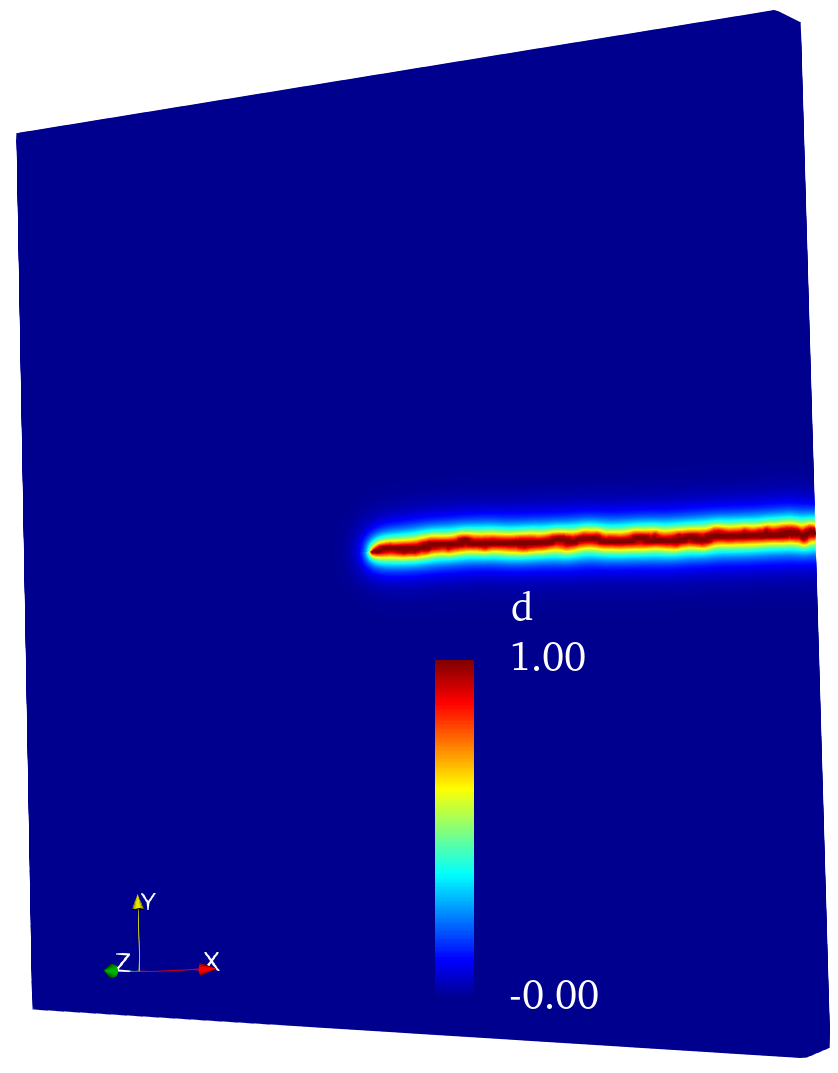
If everything goes well, you can see the following image in your Paraview: